The Long Road to Threadsinger: The History of the Danthean Chronicles


Genesis of The Threadsinger
The world that readers will encounter in Threadsinger, the first book of the Danthean Chronicles trilogy, did not emerge overnight. It began taking shape more than forty years ago, during the 1980s, when the first fragments of the planet Alean appeared as sketches, notes, maps, and half-formed ideas I had about an ideal alien world. It started with a thought experiment. If I could build my own world, what sort of world would I build? I wanted to incorporate my own ideas about art, music, design, and spirituality. At the time, it was simply an act of curiosity: What would a living world look like if its cultures were shaped by their relationship to spirit, land, and elemental forces?
That question gradually grew into something much larger.

Alean: A World Divided
At the center of the Danthean Chronicles is the planet Alean, a world defined by two great continents: Obiri and Sebros.
Obiri is the ancestral homeland of the Dantheans, whose name translates roughly as people of the spirit. Their culture is deeply rooted in spiritual awareness and an animistic understanding of the world. For the Dantheans, spirit is not something distant or abstract. It moves through the forests, rivers, wind, flame, and even the quiet emptiness of the night sky.
Their society is organized into five elemental clans, each embodying a different relationship to the living world:
- Earth Clan, grounded in endurance and connection to the land
- Air Clan, known for agility, perception, and freedom
- Water Clan, shaped by adaptability and emotional depth
- Fire Clan, driven by passion, courage, and transformation
- Void Clan, devoted to contemplation, mystery, and the unseen
These clans form the cultural and spiritual backbone of Danthean society. Each holds different traditions, strengths, and philosophies, but all share a reverence for the living spirit that flows through Alean itself.
Across the ocean lies Sebros, a continent with a very different worldview. The Sebrosians have built a powerful and rigid civilization dominated by a single, imposing religious order known as the Scytheborn.
Where the Dantheans see spirit everywhere, the Scytheborn believe spirit must be harvested, controlled, and wielded. Their religion is built around discipline, hierarchy, and conquest. The result is a culture that has grown increasingly militant and expansionist.
By the time Threadsinger begins, that expansion has reached a breaking point.
The Sebrosians have begun invading Obiri.
The Story Begins
The opening of the trilogy takes place during this rising conflict. The invasion threatens not only the Danthean clans, but the spiritual balance of Alean itself.
Caught in the middle of this growing war are three figures whose paths converge in unexpected ways.
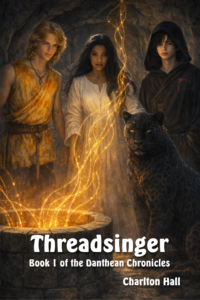
Mara, an apprentice at the Temple of Alora, is still learning the deeper mysteries of spirit and harmony as practiced by the Dantheans. Her path was meant to be one of study and guidance, not war. Yet the destruction spreading across Obiri will force her to confront challenges far beyond the walls of the temple.
Then there are Talin and Jaros, warriors of the Embe Kini.
The Embe Kini are mercenaries with a unique place in the political landscape of Alean. They are loyal to no single clan and no single nation. Because of this neutrality, they can operate where others cannot. Their services are sought in times of conflict precisely because their actions cannot easily be traced back to a particular power.
Talin and Jaros have lived their lives within that world of contracts, survival, and shifting loyalties. But war has a way of forcing people to choose sides.
As the Sebrosian invasion spreads across Obiri, the fates of Mara, Talin, and Jaros begin to intertwine. Each of them carries different strengths, different beliefs, and different internal struggles. Yet together they may represent the fragile hope that the Danthean homelands can still be defended.
Forty Years of “Field Research”
One unusual aspect of the Danthean Chronicles is the time it has taken to bring them into written form. While the first book is only now approaching completion, the world behind it has been evolving for decades. Cultures, languages, landscapes, philosophies, and spiritual traditions have been shaped gradually through years of thought, observation, and inspiration.
A lot of people might call that world-building. Some might call it ‘lazy.’ I prefer to refer to it as doing decades of field research.
The ideas that shaped Alean did not arise in isolation. They were influenced by my personal encounters with the wilderness, my own reflections on spirituality, my study of sacred paths throughout the world and across time, conversations about culture and conflict and the roots of both, and the slow accumulation of insights about human nature. Stories mature when the writer does. After 66 years of living on this planet, I finally felt ready to begin.
In that sense, the Danthean Chronicles represent not just a fictional universe, but the result of forty-plus years of curiosity about the relationship between spirit, power, and the natural world. It has been my ‘happy place’ to retreat to for most of my adult life for a bit of escapism when the ‘real world’ gets too trying.
Soon, I’ll be sharing that world with you.
Looking Ahead
Threadsinger is the beginning of a larger journey.
The trilogy will explore the escalating struggle between the Danthean clans and the Sebrosian empire, while also following the personal transformations of Mara, Talin, and Jaros. Their choices will shape not only the fate of their homelands, but the spiritual future of Alean itself.
After four decades of imagination and exploration, the world of the Danthean Chronicles is finally stepping out of notebooks, maps, and sketches and into the hands of readers.
Oddly enough, the times in which we find ourselves now reflect the conflict at the core of the story in the Danthean Chronicles. I hope that, as the books are published, they can serve in some small way as a metaphor for what we’re all going through right now, and to offer a bit of hope.